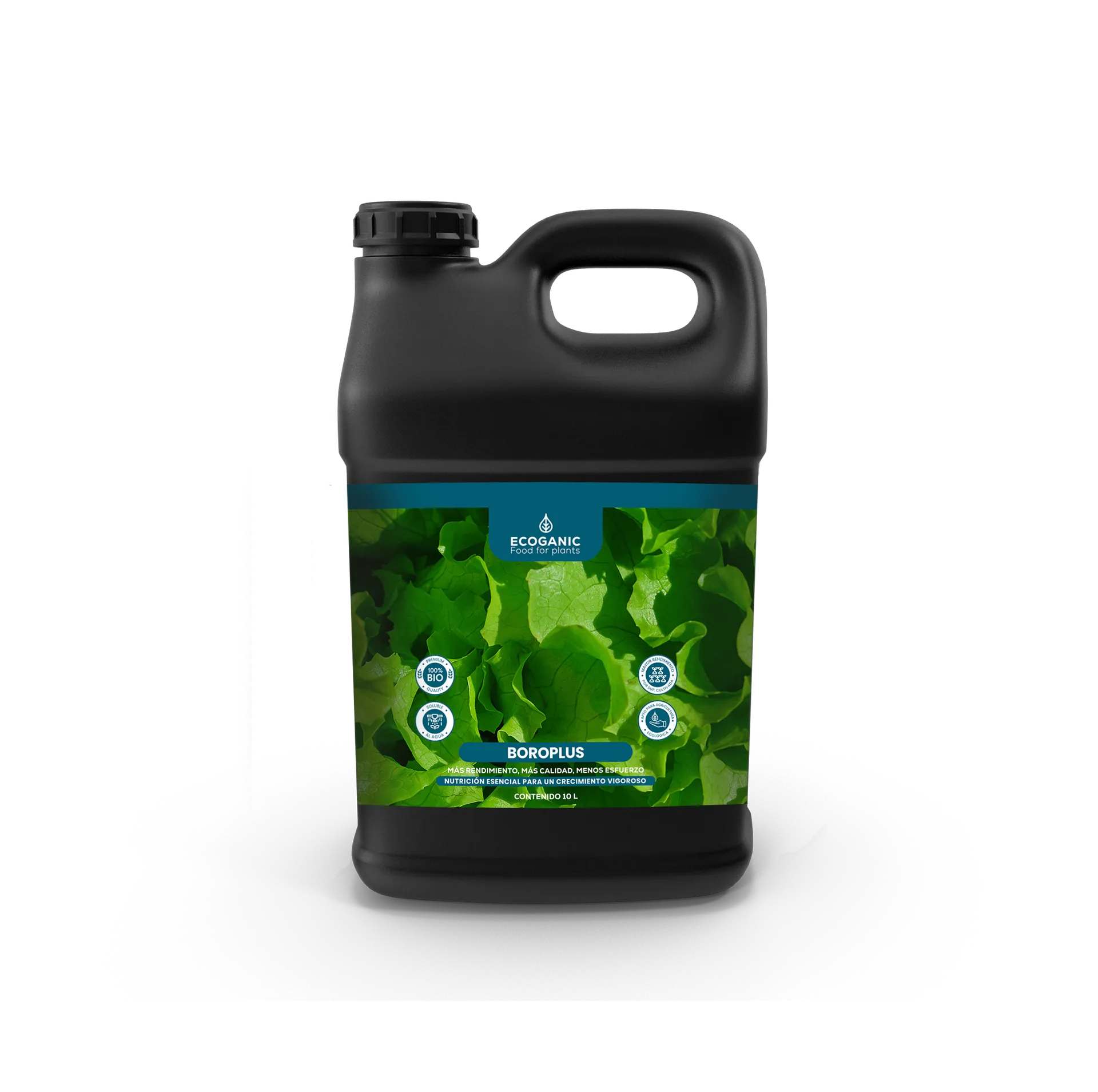
BOROPLUS
Liquid boron corrector, 100% soluble. According to our technical data sheet it is light blue, with a density of 1.21 ± 0.01 and a pH of 7.8 ± 1.0 (the central pH value is corroborated; the declared tolerance is twice as wide). The guaranteed analysis on that same data sheet…
- Origin
- Spain
- Storage
- Ambient
- Certifications
- EU BIOUSDA NOP
Overview
- 5.97% total boron measured in the laboratory
- Boron-ethanolamine in aqueous solution
- Chloride < 0.05% measured in the laboratory
- Foliar use on citrus, apple, pear and blueberry
Liquid boron corrector, 100% soluble. According to our technical data sheet it is light blue, with a density of 1.21 ± 0.01 and a pH of 7.8 ± 1.0 (the central pH value is corroborated; the declared tolerance is twice as wide). The guaranteed analysis on that same data sheet declares a minimum of 6.00% (w/w) total boron (B), 20.93% (w/w) boron oxide (B2O3) and 25.00% (w/w) freshwater unicellular algae extract. The data sheet states that boron is supplied as boron-ethanolamine in aqueous solution: it is not an EDTA, DTPA or EDDHA chelate. It is applied foliarly.
Key benefits
- 5.97% total boron measured in the laboratory
- Boron-ethanolamine in aqueous solution
- Chloride < 0.05% measured in the laboratory
- Foliar use on citrus, apple, pear and blueberry
Application
Foliar. The source records three schedules, with no crop assigned: (1) maintenance 3-6 L/ha or 300-600 cc/hl per application and, under severe deficiency, up to 4 applications at 600-800 cc/hl; (2) maintenance 3-4 L/ha or 300-400 cc/hl and, under severe deficiency, up to 4 applications at 1,000-1,200 cc/hl; (3) maintenance 2-3 L/ha or 200-300 cc/hl and, under severe deficiency, up to 4 applications at 1,000-1,200 cc/hl.
Specifications
Composition
| Total boron (B) | 5,97 % (p/p) (measured) |
|---|---|
| Total boron oxide (B₂O₃) | 20,93 % (p/p) |
| Freshwater unicellular algae extract | 25,00 % (p/p) |
| Declared chemical form of boron (qualitative data) | Boro-etanolamina en disolución acuosa |
Physical properties
| State | 100% soluble liquid |
|---|---|
| Color | Light blue |
| Density | 1,21 ± 0,01 |
| pH | 7,8 ± 1,0 |
| Chloride (Cl) | < 0,05 % p/p (measured) |
Application & dosage
| Recommended dose | Foliar. The source records three schedules, with no crop assigned: (1) maintenance 3-6 L/ha or 300-600 cc/hl per application and, under severe deficiency, up to 4 applications at 600-800 cc/hl; (2) maintenance 3-4 L/ha or 300-400 cc/hl and, under severe deficiency, up to 4 applications at 1,000-1,200 cc/hl; (3) maintenance 2-3 L/ha or 200-300 cc/hl and, under severe deficiency, up to 4 applications at 1,000-1,200 cc/hl. |
|---|---|
| Recommended crops | Citrus; Apple; Pear; Blueberry; Almond; Cherry; Peach; Avocado; Mango; Banana; Tomato; Potato; Cucumber; Melon; ; ; ; ; ; ; ; ; ; ; |
Packaging
10 L — Stackable jerrican, the usual fertigation format
20 L — Stackable jerrican, the usual fertigation format
300 L — IBC tank on pallet, for fertigation of large areas
600 L — IBC tank on pallet, for fertigation of large areas
1000 L — IBC tank on pallet, for fertigation of large areas