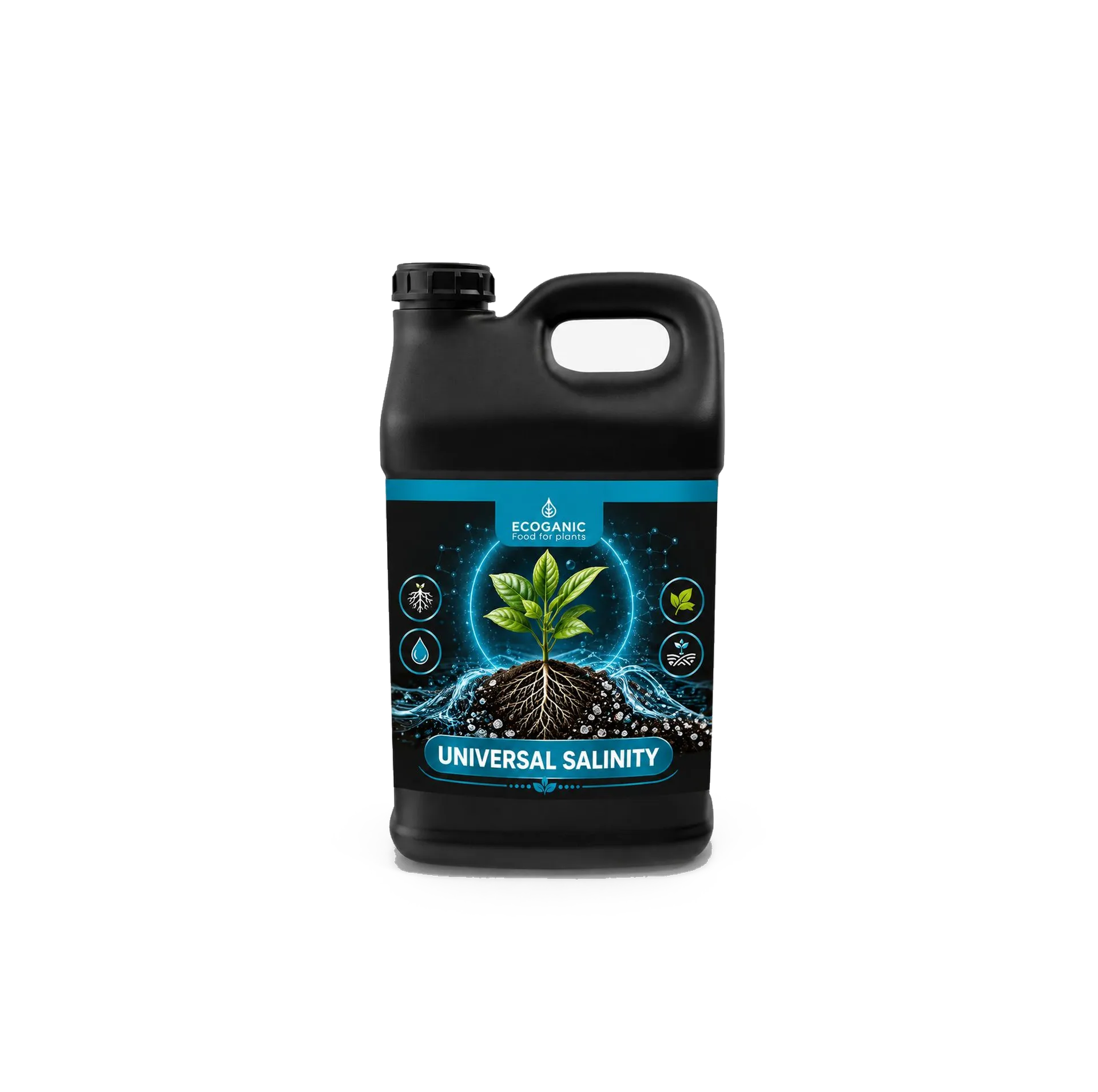
BOOST UNIVERSAL SALINITY
Brown liquid. All the analytical values below come from testing at an ENAC-accredited laboratory on a single batch and are provisional results, pending confirmation of batch-to-batch repeatability; there is no declared specification or tolerance range for them: pH 4.35;…
- Origin
- Spain
- Storage
- Ambient
- Certifications
- EU BIOUSDA NOP
Overview
- Chloride < 0.05% measured in the laboratory
- 25% freshwater unicellular algae extract
- Specific rate for saline or sodic soils: 5-10 L/ha
- 1.911% organic matter — 100% of the dry matter
Brown liquid. All the analytical values below come from testing at an ENAC-accredited laboratory on a single batch and are provisional results, pending confirmation of batch-to-batch repeatability; there is no declared specification or tolerance range for them: pH 4.35; density 1.007 g/cc at 20 °C; total organic matter 1.911% w/w, equivalent to 100.0% of the dry matter; organic carbon 1.070% w/w; C/N ratio 14.3; ash < 0.100% w/w, below the detection limit; potassium oxide (K2O) 0.0466% w/w / 0.0469% w/v and sulphur trioxide (SO3) 0.306% w/w / 0.308% w/v. The same test measured total calcium (CaO) at 0.150% w/w / 0.151% w/v, 25% below the ≥ 0.20% declared in the product's safety data sheet: a documented specification failure, and it occurs on both bases of expression. The safety data sheet also declares 25% algae solution (100% freshwater unicellular algae), a declared value that the test does not quantify. The official price list declares the product as a pH corrector and salt reducer for water and soil, and the safety data sheet identifies it as an additive for fertiliser solutions. It is applied through fertigation, preferably by drip, in the root zone.
Key benefits
- Chloride < 0.05% measured in the laboratory
- 25% freshwater unicellular algae extract
- Specific rate for saline or sodic soils: 5-10 L/ha
- 1.911% organic matter — 100% of the dry matter
Application
Drip fertigation: 2-4 L/ha, maximum 5 L/ha applied at the root; saline/sodic soils: 5-10 L/ha.
Specifications
Composition
| Total calcium (CaO) | 0,150 % (p/p) / 0,151 % (p/v) |
|---|---|
| Algae solution (100 % freshwater unicellular algae) extract | 25 % |
| Total organic matter | 1,911 % (p/p) = 100,0 % de la materia seca |
| Organic carbon | 1,070 % (p/p) |
| C/N ratio | 14,3 |
| Ash content | < 0,100 % (p/p), bajo limite de deteccion |
| Potassium oxide (K₂O) | 0,0466 % (p/p) / 0,0469 % (p/v) |
| Sulphur trioxide (SO₃) | 0,306 % (p/p) / 0,308 % (p/v) |
| Sodium oxide (Na₂O) | 0,0176 % (p/p) |
| Electrical conductivity | 3,30 mS/cm |
| Iron (Fe) | 2,83 mg/kg |
| Manganese (Mn) | 5,3 mg/kg |
| Zinc (Zn) | 39,8 mg/kg |
| Heavy metals | todos en Clase A segun el RD 506/2013, anexo V |
Physical properties
| State | Liquid |
|---|---|
| Color | Brown |
| Density | 1,007 g/cc a 20 °C |
| pH | 4,35 |
| Chloride (Cl) | < 0,05 % p/p (measured) |
Application & dosage
| Recommended dose | Drip fertigation: 2-4 L/ha, maximum 5 L/ha applied at the root; saline/sodic soils: 5-10 L/ha. |
|---|---|
| Recommended crops | General agriculture; Forestry; Floriculture; Fruit growing; Indoor plants; Wheat; Maize; Peanut; Soybean; Sweet potato; Tomato; Watermelon; Cabbage; Green pepper; ; ; ; ; |
Specifications
| Hazard classification | Not classified as hazardous under Regulation (EC) 1272/2008 |
|---|---|
| Regulatory compliance | Regulation (EC) 1907/2006 (REACH), Annex II |
Packaging
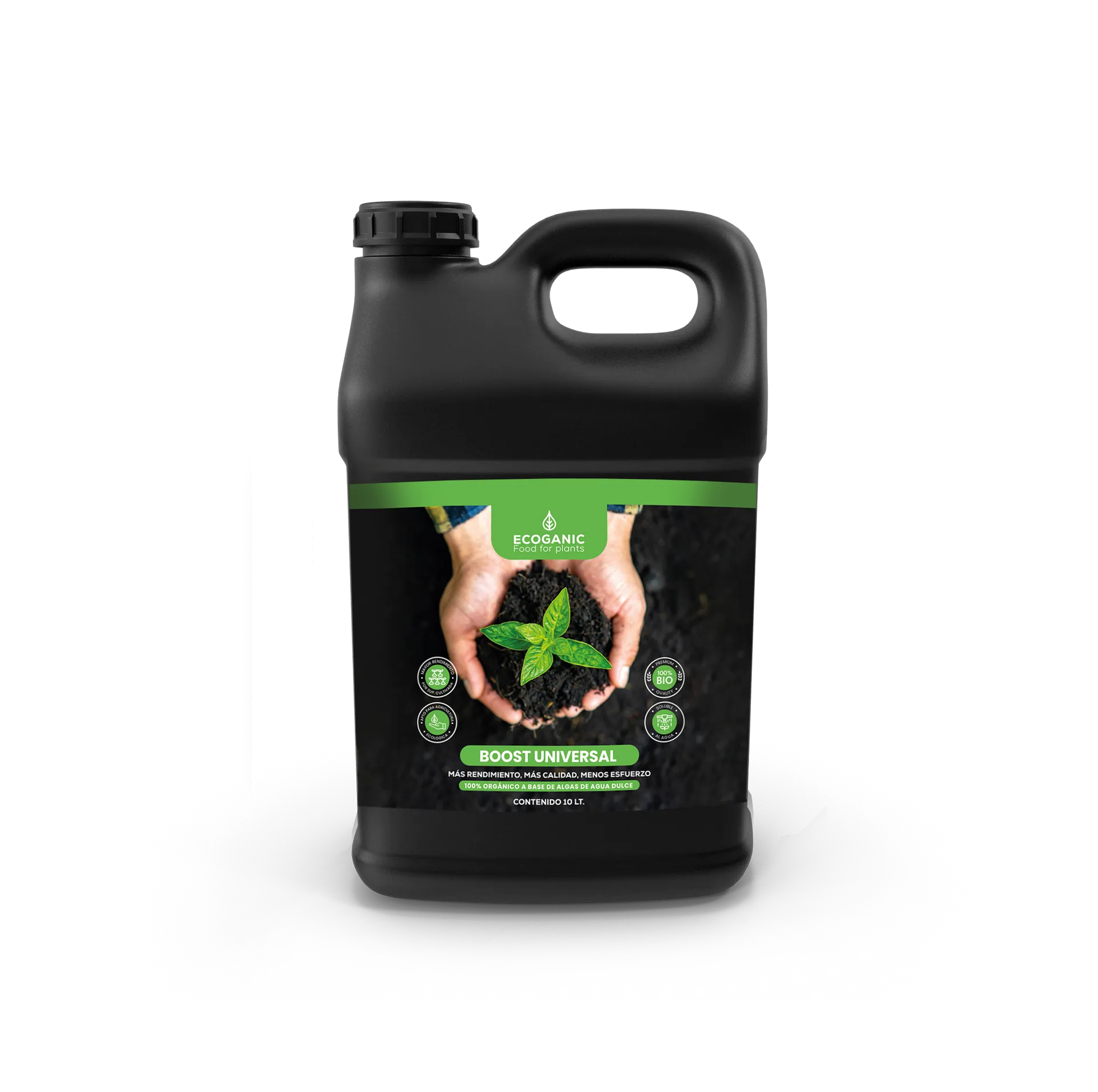
10 L — Stackable jerrican, the usual fertigation format
20 L — Stackable jerrican, the usual fertigation format
300 L — IBC tank on pallet, for fertigation of large areas
600 L — IBC tank on pallet, for fertigation of large areas
1000 L — IBC tank on pallet, for fertigation of large areas